

npx @webhooktrap/agent@1 in place of webhooktrap. Every command prints its usage with --help. An unknown command exits 2.
version
webhooktrap with no arguments and webhooktrap --version do the same.
pair
SHA256:…, as the browser shows it), and asks Join? [y/N]. When you don’t join, it unpairs and deletes the key.
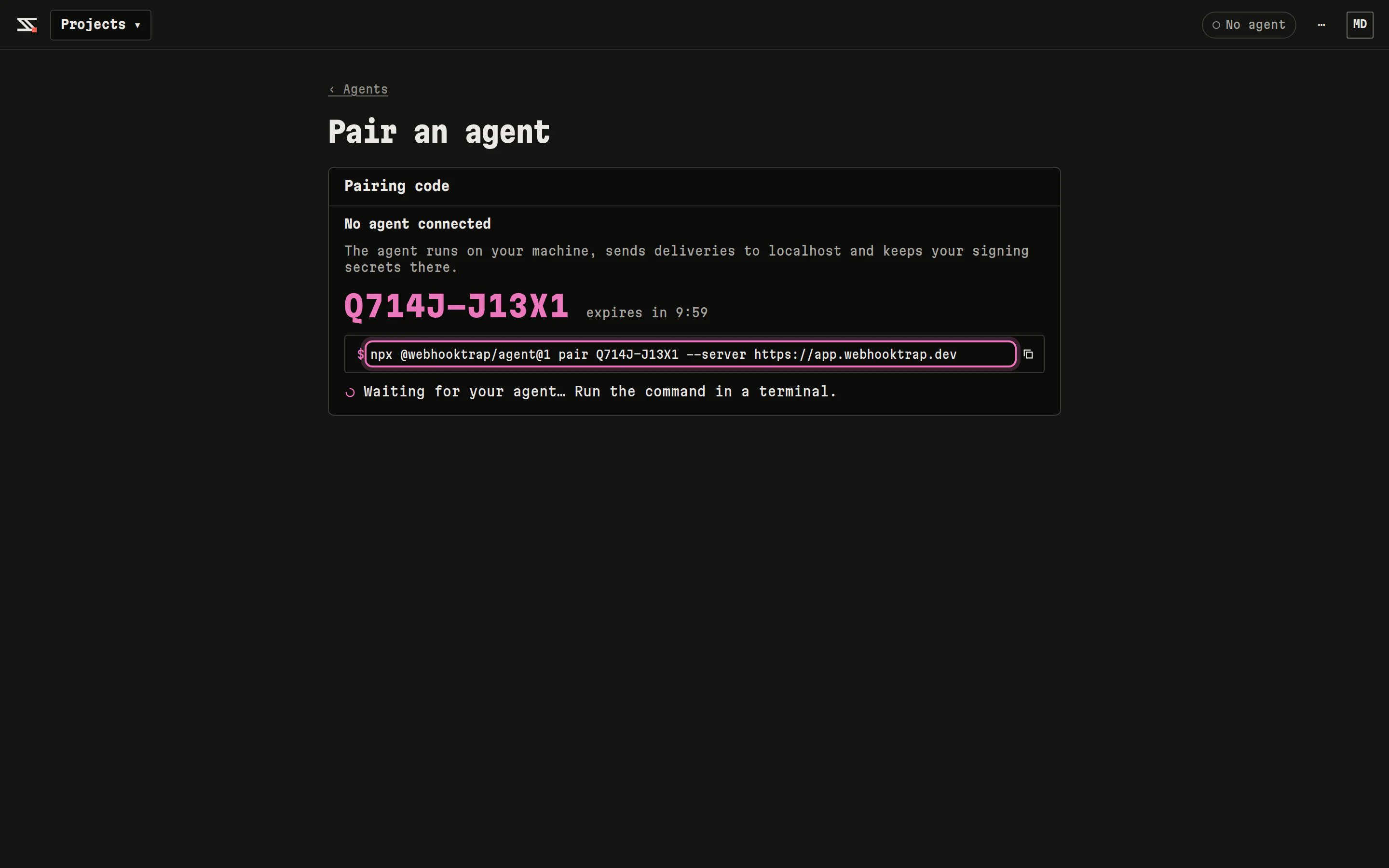
Agents › Pair a new agent shows the code and the command.
webhooktrap agent pair <CODE> is the same command.
https:// is required and verified against the system roots. Redirects are never followed.
Without a terminal, pair can’t ask and doesn’t join, unless --yes applies.
agent
webhooktrap.yml. It sends a heartbeat every 20 seconds, waits for jobs, and reconnects with backoff (up to 60 s) when the connection drops. Ctrl-C stops it.
Before a run reaches a new target, the agent asks in the terminal whether runs from the browser may send to it, with the side-effect warning. If webhooktrap.yml has cmd: probes or a reset, it lists them and asks again whenever the file changes. Without a terminal it declines the job as needing confirmation, prints one line, and checks again after 5 s, 10 s, 20 s, up to 1 minute.
webhooktrap agent unpair [--server URL] removes the agent on the server and deletes its local key.
test
webhooktrap.yml with local fixtures, prints the verdict, writes the run document and exits per --fail-on. No server is involved. See Test in CI.
rejudge
Environment variables
Server commands
The image also runs the engine as services:serve-sandbox and its health check sandbox-ping (the app’s network-free sandbox), and serve-run (the server runner). They are started by Docker Compose and are not meant to be run by hand. See Self-host.